Security
Your portfolio is encrypted on your iPhone. We hold the unreadable result; you hold the key.
Last updated: 27 July 2026
In one sentence
Raqib encrypts your portfolio on your device with a key that never leaves it, so our servers store data we are not able to read.
How the encryption works
- When you set up your portfolio, your iPhone generates a 256-bit encryption key and stores it in the device keychain. It is marked device-only and non-syncable, so it is not copied to iCloud and not restored onto another device from a backup.
- Your holdings, purchase lots, prices, dates, watchlist and questionnaire answers are gathered into one structure and encrypted with AES-256-GCM before anything is sent.
- What reaches our servers is a single block of unreadable bytes per account, plus a counter used to stop two devices overwriting each other.
- Every decryption is authenticated. If a stored block were altered by even one bit, your app would reject it rather than show you something wrong.
- Portfolio value, gains, dividend estimates and projections are computed on your device from your own records, using decimal arithmetic rather than floating point, and are never transmitted.
Your recovery code
- Because the key lives on your device, a new device needs a way in. That way is a recovery code your iPhone generates — 25 characters, machine-generated, never chosen by you and never seen by us.
- Your device uses that code to wrap a copy of your encryption key. We store only the wrapped bytes and the public parameters needed to unwrap them; without the code they cannot be unwrapped, including by us.
- Synchronisation is not switched on until you have been shown the code and typed it back, so a portfolio is never quietly protected by something you did not save.
- After you confirm it, the code is never shown again unless you deliberately generate a new one, which requires unlocking your device with Face ID, Touch ID or your passcode.
The consequence, stated plainly
If you lose every device you use Raqib on and your recovery code, nobody can recover your encrypted portfolio — including us. Your account still works and you can start again, but the old data stays unreadable. There is no master key we are choosing not to use; there is no master key at all.
What our administrators can and cannot access
What we can see
- Your name and email address, because signing you in and sending verification codes requires them, along with your account’s status and when it was last active.
- That an account exists, that it has an encrypted portfolio, roughly how large that block is, and when it last changed.
- Aggregate, non-financial usage counts — how many people opened the app, whether imports are succeeding, error rates.
- Operational health: uptime, response times, database and market-data status.
What we cannot see
- Your holdings, share counts, purchase prices, dates or cost basis.
- Your portfolio’s value, your gains or losses, or your dividend estimates.
- Your watchlist or your questionnaire answers.
- Any statement you imported — not the file, not its name, not the text read from it.
This is enforced by the database itself, not only by our code. The usage dashboard we use to see how Raqib is doing connects with a database role that has no permission to read the tables holding encrypted portfolios or recovery material — the database refuses those queries outright. A separate screen, which only the owner of Raqib can open, lists account details and nothing else: an account’s identifier, email address, display name, the date it was created, whether its email is verified, its status, and when it was last active. Opening that screen needs a fresh single-use code from the owner’s authenticator app and a written reason, it locks itself again after ten minutes, and every unlock, search, filter, page of results and account opened is written to an append-only log. It cannot reach your holdings, your portfolio’s value, your watchlist, the contents of your vault, your password, your recovery code or any encryption key.
On your device, and offline
- Your device keeps an encrypted copy of your portfolio so the app works without a connection. That local copy is in the same unreadable format we store, protected further by iOS file encryption.
- Edits made offline are saved immediately and synchronised when you are back online. Nothing is lost if the connection drops mid-change.
- If you edit on two devices before they sync, your device decrypts both versions locally and asks what to keep, defaulting to keeping everything from both. Our servers never merge anything, because they cannot read either version.
- Signing out removes the encryption key and the local copy from that device.
How we check that this is true
These are not just design intentions. Our automated tests encrypt a portfolio containing unique marker values, store it the way the real app does, and then search for those markers everywhere they could leak — every table and column in the database, a real database dump, the server logs, and the contents of every network request. The suite fails if a marker is found anywhere, and it also fails if a retired endpoint that once handled plaintext portfolios ever reappears in the app.
We describe our own engineering work here. Raqib holds no security certification and has not been independently audited, and we do not claim otherwise.
What this looks like in the app
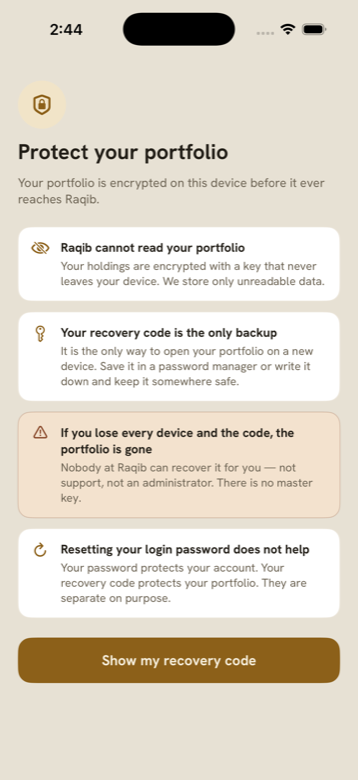
The recovery-code screen from a development build. It states the trade-off before synchronisation is enabled.
Reporting a security concern
If you believe you have found a vulnerability, please write to us with enough detail to reproduce it, and give us a reasonable opportunity to fix it before publishing. We will confirm that we received your report.